GHK-Cu: Premium Copper Peptide Complex
About GHK-Cu:
Advance your tissue remodeling and cellular regeneration studies with the premium GHK-Cu copper peptide complex from Riptide Labs. This widely studied tripeptide-copper complex naturally occurs in human plasma, but its systemic concentration declines significantly with age. Scientific researchers frequently select GHK-Cu for experimental protocols because it plays a critical governing role in regulating skin matrix synthesis, wound healing pathways, and cellular survival. Riptide Labs subjects every production lot to comprehensive analytical testing, which guarantees exceptional stability, precise copper binding, and maximum chemical purity for your laboratory settings.
The GHK-Cu peptide complex provides impressive biochemical versatility across multiple research applications. This compound acts directly as a potent signal peptide that modulates gene expression across thousands of human genes. It upregulates key extracellular matrix components, which actively encourages collagen and elastin production within structural skin models. Consequently, researchers routinely deploy GHK-Cu to examine dermal thickness, tissue elasticity, and micro-vessel formation. Furthermore, the tripeptide complex exhibits strong antioxidant activity, which helps neutralize destructive free radicals and reduce oxidative stress markers in cellular cultures. By sourcing your materials from Riptide Labs, you receive a stable, standardized compound that yields consistent, reproducible outcome data.
Understanding the unique mechanism of action enables researchers to maximize the utility of GHK-Cu in laboratory protocols. The core tripeptide sequence, Glycyl-H-Histidyl-L-Lysine, possesses a high binding affinity for copper (II) ions. Once bound, the complex efficiently shuttles essential copper directly into target cells, where it serves as a crucial cofactor for key enzymatic processes. For instance, the compound activates lysyl oxidase, an enzyme essential for cross-linking collagen and elastin fibers into stable tissue architectures. Additionally, it modulates decorin expression, which actively prevents excess scar tissue formation during rapid tissue repair. Through these multi-faceted pathways, the complex promotes balanced structural regeneration while controlling unwanted fibrotic signaling.
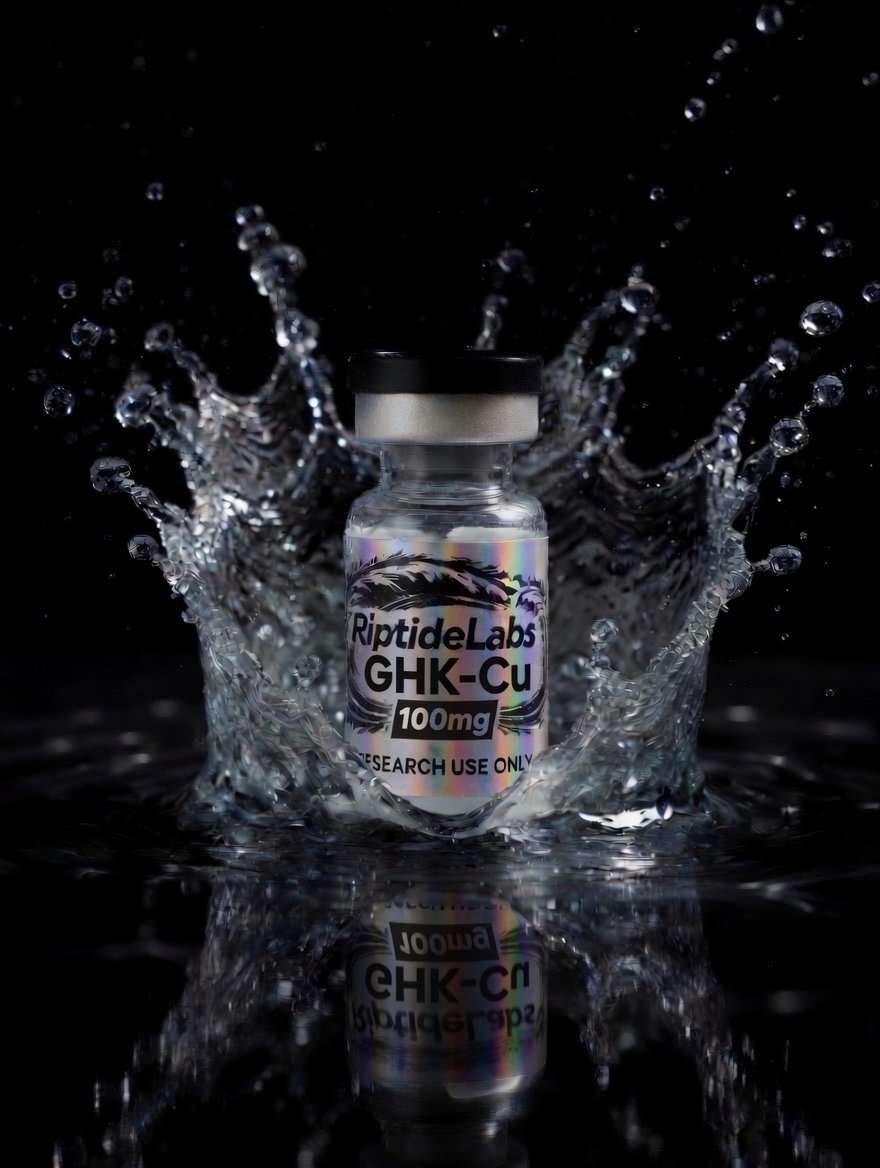
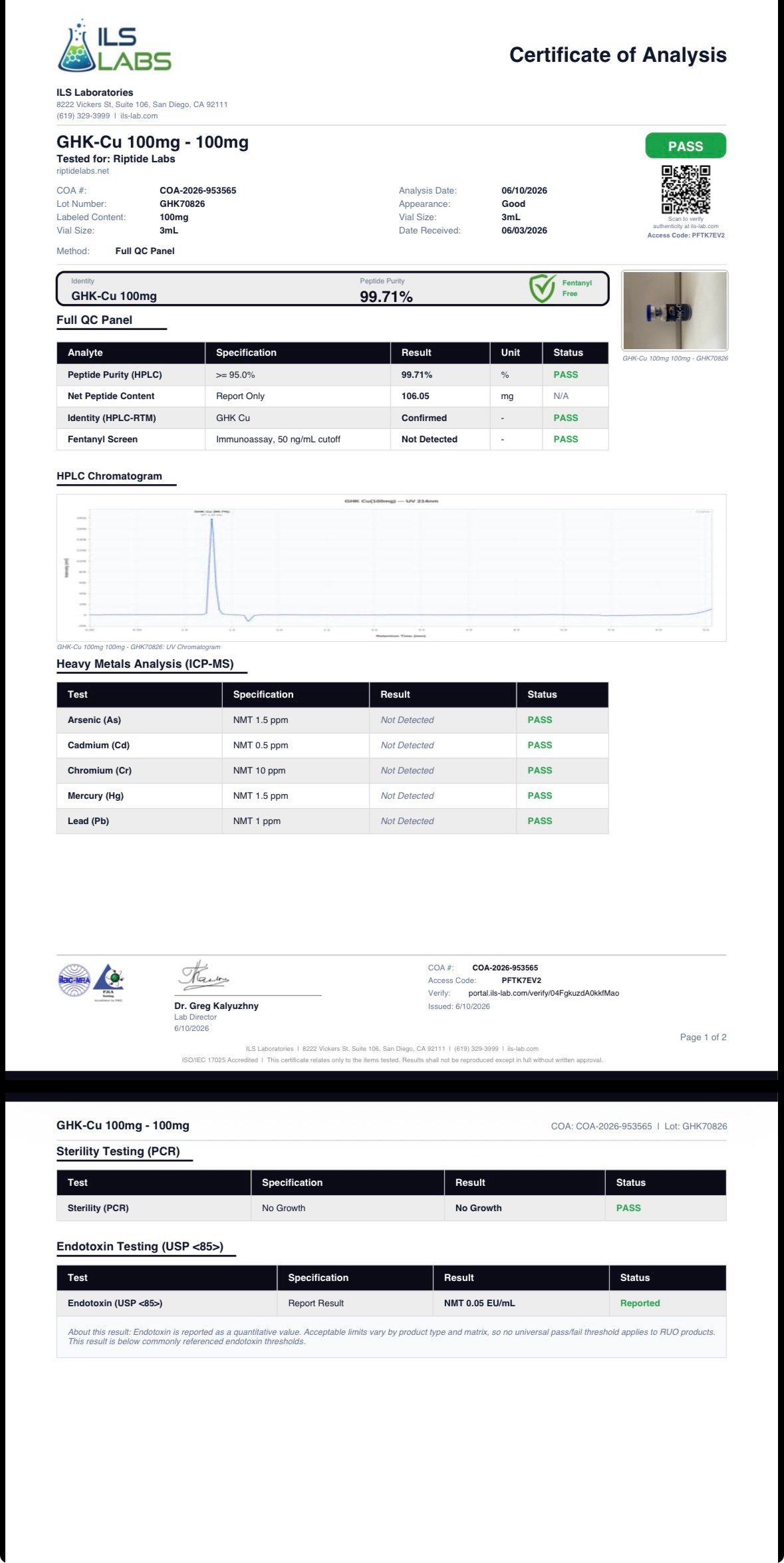
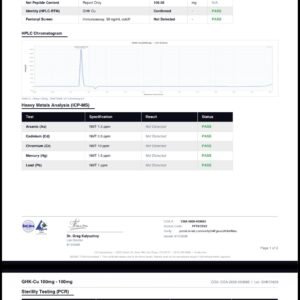
Riptide Labs manufactures every peptide batch under rigorous analytical standards to ensure top-tier scientific reliability. Each vial contains pure Glycyl-H-Histidyl-L-Lysine copper complex provided in a stable, lyophilized powder form. High-Performance Liquid Chromatography (HPLC) and Mass Spectrometry testing confirm a purity grade equal to or exceeding 98.0%. The physical material presents as a distinct, sterile blue freeze-dried cake, reflecting the characteristic presence of bound copper ions. This powder dissolves rapidly in standard aqueous solvents, such as Bacteriostatic Water or Sterile Water for Injection. To preserve long-term bioactivity, store un-reconstituted vials between 2°C and 8°C while keeping the container fully protected from direct light exposure.
Proper preparation techniques ensure that your GHK-Cu material retains maximum integrity during active research cycles. Store dry vials in cold storage prior to reconstitution. When you are ready to prepare your working solution, inject your chosen diluent slowly down the inner glass wall of the container. Do not spray liquid directly onto the freeze-dried cake. Gently swirl the glass vial using smooth circular movements until the solid mass dissolves completely into a clear blue fluid. Avoid shaking the vial vigorously, because aggressive physical agitation can destabilize peptide bonds. Following reconstitution, refrigerate the liquid mixture and complete your planned evaluations within your designated experimental schedule.
This GHK-Cu research compound from Riptide Labs is manufactured strictly for laboratory, scientific, and chemical testing purposes. It is explicitly not cleared or intended for human consumption, cosmetic application, animal administration, diagnostic procedures, or therapeutic use. Authorized research technicians must handle all materials in compliance with standard biosafety guidelines and appropriate personal protective equipment protocols.
| Quantity | 100mg, 100mg KIT (10 VIALS) |
|---|
4 reviews for GHK-Cu
Add a review
Related products
Peptides
Peptides
Peptides
Peptides
Peptides
Peptides
Peptides
Peptides
Johnny –
We utilize GHK-Cu to investigate extracellular matrix synthesis and gene modulation in structural skin models. The characteristic deep blue lyophilized cake indicates precise copper (II) ion chelation and high structural integrity. Reconstitution in sterile bacteriostatic water yielded a clear blue solution instantly, and our internal HPLC confirmed the \ge 98.0\% purity mark.
Jasmine –
Sourcing copper peptides with reliable binding affinity and zero free copper contamination is critical for our lysyl oxidase activation assays. Riptide Labs provided detailed MS and HPLC documentation that matched our independent testing. The compound significantly upregulated collagen and elastin cross-linking parameters in our culture sets.
Maxwell –
Our protocols evaluate decorin expression and scar tissue suppression during rapid cellular repair. Riptide’s GHK-Cu complex showed strong antioxidant protection against oxidative stress markers, preserving cell viability across extended observation periods. Batch-to-batch consistency across our last three orders has been flawless.
Maxzime –
Our protocols evaluate decorin expression and scar tissue suppression during rapid cellular repair. Riptide’s GHK-Cu complex showed strong antioxidant protection against oxidative stress markers, preserving cell viability across extended observation periods. Batch-to-batch consistency across our last three orders has been flawless.